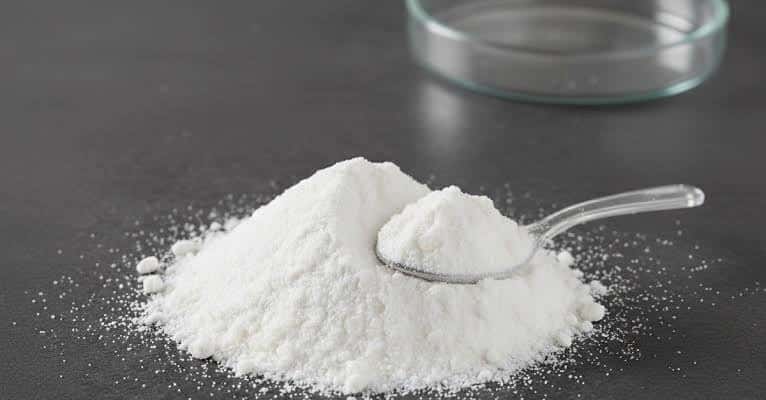
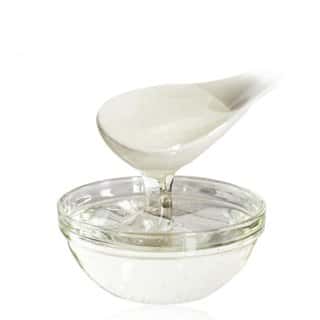
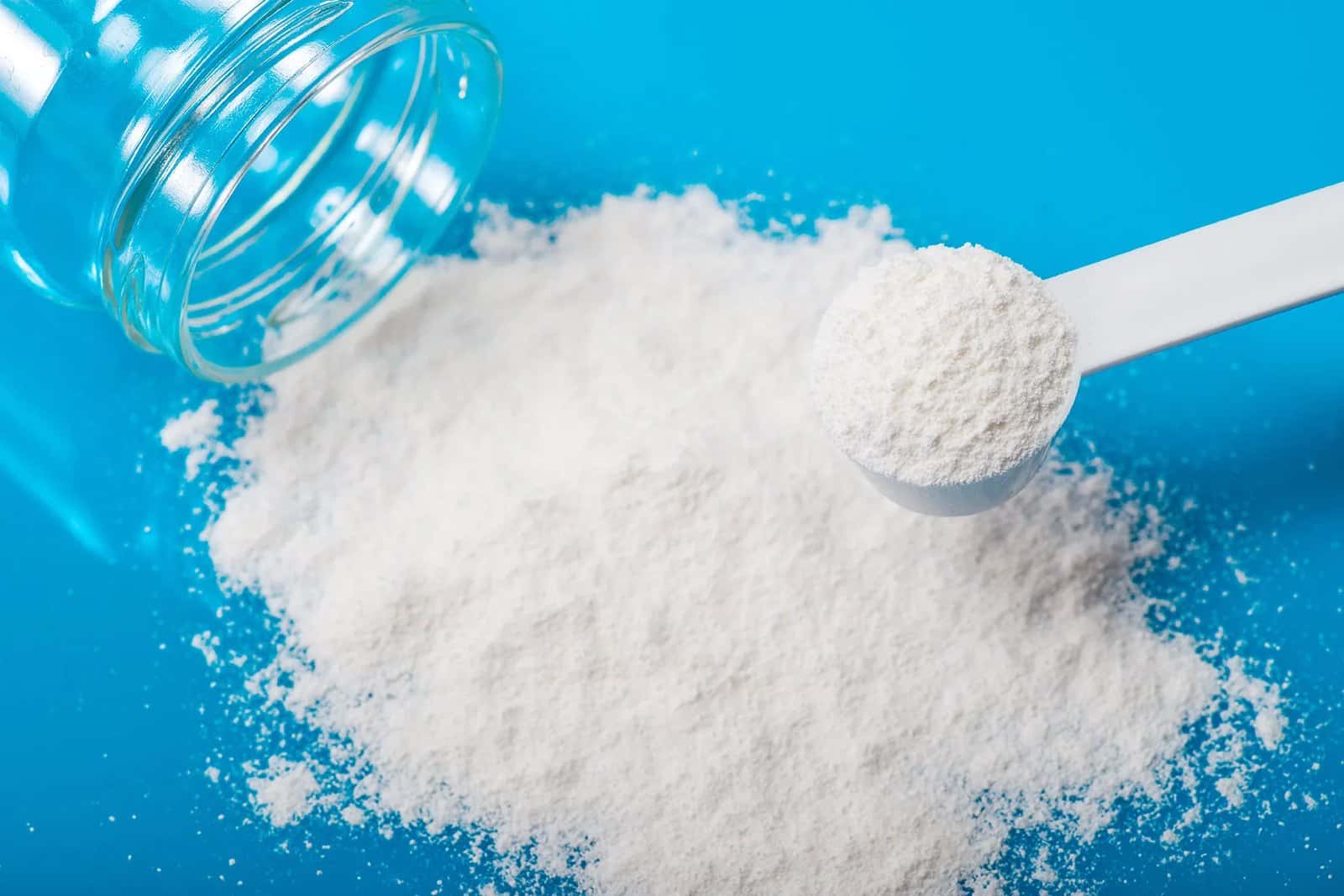
Maltodextrin and glucose syrup are made the same way, by partially hydrolysing starch, and both can be bought as white powders. The difference is how far hydrolysis has gone, measured as dextrose equivalent (DE). Regulators and the industry draw the line at DE 20: below it the product is maltodextrin, and at or above it the product is glucose syrup, or dried glucose syrup in powder form. This guide explains why the line matters and how to choose.
Same process, different end point
Starch is a long chain of glucose units. Gelatinising it in water and hydrolysing it with acid or enzymes cuts the chains into shorter pieces. DE expresses the reducing sugar content as dextrose per 100 g of dry matter. Pure dextrose scores 100, and the shorter the average chain, the higher the DE. Stopping early gives long chains and a low DE, which is maltodextrin. Food-grade digestible maltodextrins typically fall between DE 3 and 20. Going further gives glucose syrups, starting at DE 20 and extending roughly to DE 75 in the literature. Either can be spray-dried. A dried product above DE 20 is dried glucose syrup, also sold as glucose syrup solids or corn syrup solids.
Side-by-side comparison
| Parameter | Maltodextrin | Glucose syrup / dried glucose syrup |
|---|---|---|
| Dextrose equivalent | < 20 (typically 3–20) | ≥ 20 |
| Defining text | 21 CFR 184.1444 (US); no EU legal definition | Codex CXS 212-1999; Directive 2001/111/EC; 21 CFR 168.120 / 168.121 |
| Forms | White powder (also concentrated solution) | Syrup (≥ 70% solids) or dried powder (≥ 93% solids, Codex/EU) |
| Sweetness | Described as nonsweet (US) / low | Low to moderate, rising with DE |
| Viscosity, binding, anti-crystallising power | Higher | Lower, and decreasing as DE rises |
| Hygroscopicity, browning, fermentability | Lower | Higher, and increasing as DE rises |
| US status | GRAS, 21 CFR 184.1444 | Standards of identity in Part 168; corn syrup GRAS, 21 CFR 184.1865 |
| EU ingredient name | Maltodextrin (no category name) | "Glucose syrup" (Reg. 1169/2011, Annex VII) |
Why the DE 20 line matters to buyers
- Labelling: a powder at DE 18 is declared as maltodextrin, while one at DE 24 is dried glucose syrup, labelled as glucose syrup or corn syrup solids depending on market. Changing the DE grade can change your ingredient list.
- Regulatory basis: in the US, maltodextrin falls under 21 CFR 184.1444, which names corn, potato and rice starch. Dried glucose syrup falls under the 21 CFR 168.121 standard of identity. In the EU, glucose syrup and dried glucose syrup are defined in Directive 2001/111/EC, while maltodextrin has no legal definition and is generally understood as a starch hydrolysate below DE 20.
- Specification checks: both are white powders, so DE on the COA is the main way to confirm you received the product you ordered.
Functional differences
As DE rises, sweetness, hygroscopicity, browning, flavour enhancement and fermentability increase. As DE falls, viscosity, binding power, anti-crystallising power and water activity rise, and the freezing point is depressed less. In practice:
- Maltodextrin suits bulking without sweetness, flavour and spray-drying carriers, film forming, and body in dry soups, sauces and powdered drinks. It is also a carbohydrate source in specialised nutrition and a tablet and powder excipient in pharmaceutical grades.
- Glucose syrup suits confectionery crystallisation control, ice cream smoothness, moisture retention in bakery, and body and gloss in jams and sauces. Higher-DE grades add more sweetness and browning.
- Dried glucose syrup sits between them. It works in dry mixes when you want a little more sweetness and solubility than maltodextrin provides.
Choosing between them
- Need solids, body or a carrier with minimal sweetness and low moisture pick-up? Choose a low-DE maltodextrin.
- Need to stop sucrose crystallising, add chew or keep a product soft? Choose a glucose syrup, with the DE matched to the texture target (confectionery, bakery).
- Need the glucose syrup function in a dry process? Choose dried glucose syrup, but expect more hygroscopicity than maltodextrin.
- Need full fermentability or a crystalline sugar? Neither fits; consider dextrose.
Logistics: powder vs syrup
Maltodextrin ships in bags, commonly 25 kg, and like dried glucose syrup it must be kept dry. Glucose syrup ships as a liquid in drums, IBC totes, flexitanks or road tankers. Lower-DE syrups are more viscous, so unloading arrangements matter. For the dextrose side of the comparison, see glucose syrup vs dextrose.
Buying through ANUTIDA
ANUTIDA quotes maltodextrin and glucose syrup against the producer's specification, with DE, solids or moisture and the other agreed parameters reported on each lot's Certificate of Analysis. Tapioca starch is the main raw material for Thai starch sweeteners, and feedstock and origin are stated in each quotation. Include your DE range, feedstock preference, packaging and volumes in the RFQ.
Frequently asked questions
Is corn syrup solids the same as maltodextrin?
No. Corn syrup solids is dried glucose syrup with a DE of 20 or more. Maltodextrin has a DE below 20. They are made the same way but are labelled and regulated differently.
Which is sweeter, maltodextrin or glucose syrup?
Glucose syrup. Sweetness rises with DE, and the US regulation describes maltodextrin as nonsweet. Even glucose syrups are less sweet than sucrose at low DE.
Can I use maltodextrin instead of glucose syrup in candy?
Not directly. Maltodextrin adds body and binding, but candy recipes rely on glucose syrup's liquid form, solids and crystallisation-control profile. Any substitution needs reformulation and trials.
Sources & references
- Government21 CFR 184.1444 Maltodextrin — US Government Publishing Office / eCFR
- Government21 CFR 168.120 Glucose sirup — US Government Publishing Office / eCFR
- Government21 CFR 168.121 Dried glucose sirup — US Government Publishing Office / eCFR
- Government21 CFR 184.1865 Corn syrup — US Government Publishing Office / eCFR
- Standards bodyStandard for Sugars (CXS 212-1999, amended 2001) — Codex Alimentarius Commission (FAO/WHO)
- RegulatorCouncil Directive 2001/111/EC relating to certain sugars intended for human consumption (consolidated 18.11.2013) — EUR-Lex, European Union
- RegulatorRegulation (EU) No 1169/2011 on the provision of food information to consumers (consolidated 01.04.2025) — EUR-Lex, European Union
- ResearchNutrition, Health, and Regulatory Aspects of Digestible Maltodextrins (Crit Rev Food Sci Nutr 2016;56(12):2091–2100) — Hofman DL, van Buul VJ, Brouns FJPH — Taylor & Francis (open access, PMC4940893)
- ResearchThe Influence of Starch Sweeteners on Functional Properties of Cellulose Fat Mimetics (Polymers 2023) — MDPI (open access, PMC10386183)
- Industry bodyTapioca Utility — multiple uses of tapioca starches — Thai Tapioca Starch Association