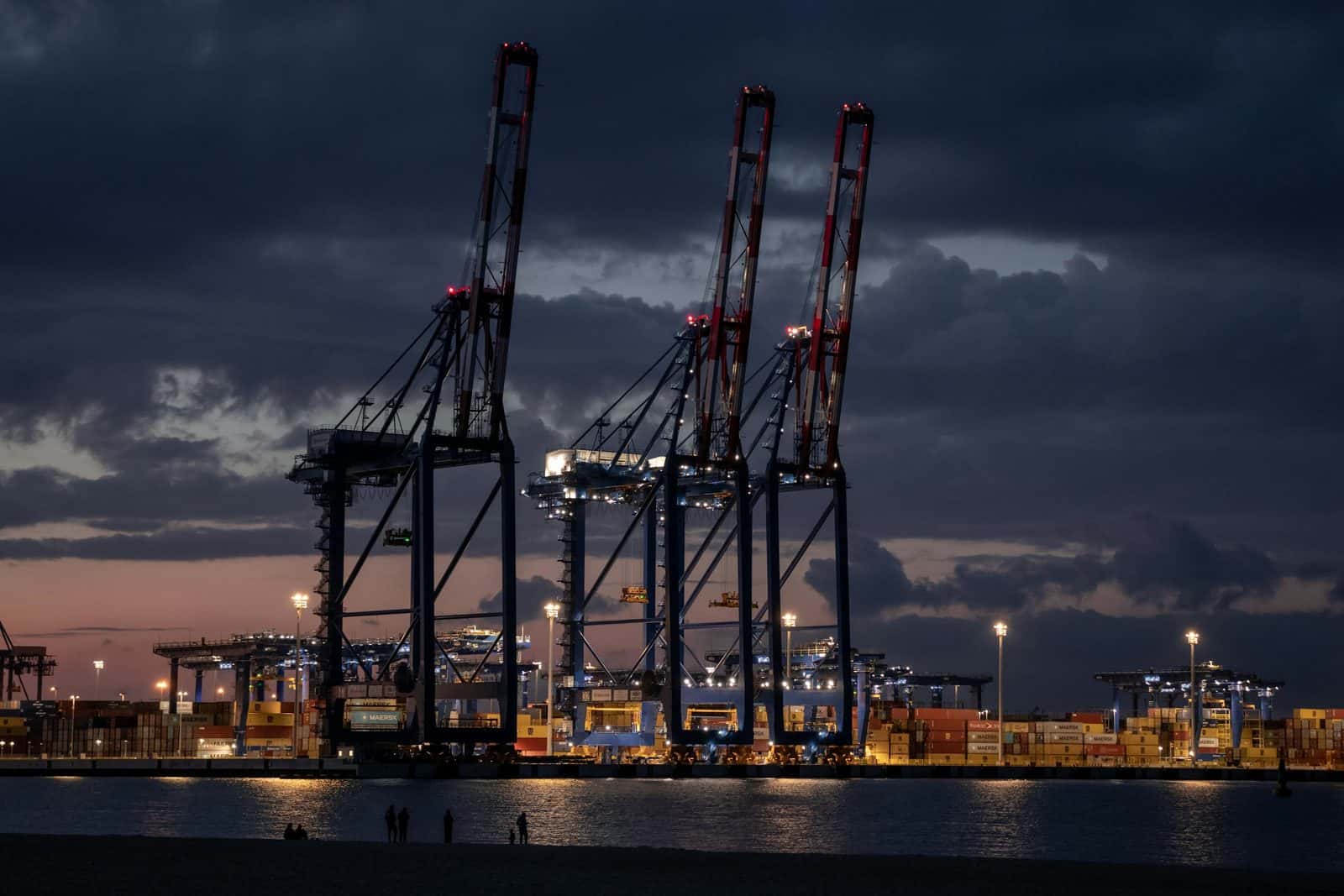
Export logistics
Sugar Export Logistics from Thailand
From Thai stock to your port
Every ANUTIDA shipment follows the same sequence: the product and specification are confirmed in the contract, the lot is allocated and packed in the agreed format, containers are inspected and loaded, export clearance is completed in Thailand, and the cargo leaves on the agreed Incoterm — by sea from a Gulf of Thailand port, or overland to neighbouring countries. You receive the shipping documents your contract and payment terms require.
- Contract — product, specification, quantity, packaging, Incoterm, destination port and payment terms agreed in writing.
- Allocation and packing — the lot is allocated from stock or production and packed in the agreed bags, jumbo bags or liquid containers, marked as required.
- Inspection — optional independent inspection (sampling, weighing, container condition, loading supervision) by the inspection company you nominate.
- Container loading — clean, dry, odour-free containers, lined where required, loaded within the carrier's payload and the verified gross mass (VGM) declared.
- Export clearance and sailing — customs export formalities in Thailand, then loading on the vessel at the port of shipment.
- Documents — commercial invoice, packing list, bill of lading, certificate of origin, certificate of analysis and any agreed certificates, presented as your payment terms require.
Packaging formats
Refined and white sugar for export is normally packed in 50 kg woven polypropylene bags with a polyethylene liner. The liner protects the sugar from moisture and contamination; reference contracts such as the ICE White Sugar contract set the same construction (new polypropylene bags, a single new polythene liner, minimum 50 kg net) and require English marks on every bag — product, net weight, origin, crop or production year and producer.
| Format | Typical use | Handling |
|---|---|---|
| 50 kg PP bag with PE liner | Refined and white sugar for export, distributors, food manufacturing | Floor-loaded or palletised in 20 ft containers |
| 25 kg bag | Bakeries and lines where manual handling limits apply; powdered products | Palletised; more units per tonne |
| Jumbo bag (FIBC), about 1 tonne | Mechanised plants with bulk-bag dischargers | Forklift handling; fewer units, faster discharge |
| Bulk in vessel holds | Raw and high-pol sugar for refineries | Loaded at sugar terminals or by transhipment |
| Drums, IBCs, flexitanks, tankers | Liquid sugar and syrups | Food-grade liquid logistics |
How much sugar fits in a container?
Sugar is dense. Marine cargo references give stowage factors for bagged sugar of roughly 1.1–1.3 cubic metres per tonne (wider ranges are quoted), so in a 20 ft container (about 33 m³) the weight and volume limits are close, while a 40 ft container runs out of weight allowance long before it is full. Carriers publish maximum payloads for standard 20 ft dry containers of about 28.1–28.3 tonnes, and 40 ft containers carry little or no more — between about 26.8 and 28.9 tonnes depending on the box's rating. That is why bagged sugar moves almost entirely in 20 ft containers. See how much sugar fits in a container for worked examples.
| Container | Maximum payload | Source |
|---|---|---|
| 20 ft standard dry | 28,300 kg (Maersk) · 28,330 kg (ONE) | Carrier specifications |
| 40 ft standard dry | 28,870 kg (Maersk) · 26,840 kg (ONE, 30,480 kg rating) | Carrier specifications |
| 40 ft high cube | 28,690 kg (Maersk) | Carrier specifications |
A common loading pattern for 50 kg bags is 540 bags (27 tonnes net) per 20 ft container, but the right figure for your shipment depends on the carrier's payload, the container's tare, inland road limits and whether the bags are palletised. Since 1 July 2016 the shipper must declare a verified gross mass (VGM) for every packed container under the IMO SOLAS rules, and an overweight container cannot be loaded on a ship.
Protecting sugar in transit
- Dry, clean, odour-free containers. Sugar absorbs odours and moisture; containers are inspected before loading and are commonly lined with kraft paper.
- Humidity. Marine cargo guidance puts the recommended relative humidity for white sugar at about 55–65%. Above roughly 70% sugar can become tacky; drying afterwards causes caking.
- Condensation. Sugar holds its loading temperature, so moving from cool to hot, humid conditions can cause sweat on bags. Prompt discharge and dry stowage reduce the risk.
- Handling. Bags are marked “Keep dry” and “Use no hooks”; hooks tear bags and let moisture in.
- Wooden pallets must be ISPM 15 treated and marked for international shipment.
Ports and inland routes
Thailand's deep-sea sugar exports move through the Gulf of Thailand ports of Laem Chabang and Si Racha in Chonburi, where specialised terminals handle bulk and bagged sugar, with Ko Sichang anchorage used for mid-sea transhipment of bulk cargo. Riverside terminals on the Chao Phraya, including Bangkok Port, serve smaller vessels.
ANUTIDA is based in Udon Thani in the Northeast — the region that produces roughly half of Thailand's raw sugar, which is trucked south to the Gulf ports. Udon Thani is about 564 km from Bangkok by highway; containers can also move by rail through the Northeast rail terminals and the Lat Krabang inland container depot, which runs daily rail shuttles to Laem Chabang. For neighbouring Laos, the First Thai–Lao Friendship Bridge at Nong Khai, the province next to Udon Thani, carries road and rail traffic to Vientiane.
Incoterms and shipping terms
ANUTIDA quotes on the Incoterms® 2020 rule you request. For containerised sugar, ICC guidance recommends the any-mode rules (FCA, CPT, CIP) because containers are handed over at the terminal, while FOB, CFR and CIF are designed for cargo loaded directly on board — typically bulk. In practice many buyers still request CFR or CIF; we confirm exactly where delivery and risk transfer happen in every quotation. The export page explains each term for sugar buyers.
Frequently asked questions
How many tonnes of sugar go in a 20 ft container?
It is limited by the carrier's maximum payload (about 28 tonnes of cargo for a standard 20 ft dry container), the container tare, road-weight rules and palletisation. A commonly cited loading pattern is 540 × 50 kg bags — 27 tonnes net — per 20 ft container. The exact net weight is fixed in the contract and at booking.
Why not ship sugar in 40 ft containers?
Because sugar is heavy for its volume. A 40 ft container's payload is about the same as — or less than — a 20 ft container's, so it carries little or no more sugar at a higher freight cost.
Can sugar be shipped on pallets?
Yes, if your warehouse prefers palletised cargo. Wooden pallets must meet ISPM 15. Palletising usually reduces the net weight per container slightly; floor loading maximises it.
Do you ship by land to neighbouring countries?
Thai sugar is traded overland to neighbouring markets such as Laos and Cambodia. Tell us the destination and border crossing in your request and the route is confirmed in the quotation.
Can I appoint my own inspection company?
Yes. Independent inspection — sampling, weighing, container condition checks and loading supervision — can be arranged by the buyer's nominated inspection company. State it in your request so it is built into the contract.
Last updated 6 October 2026
Request a quotation
Get a delivered quotation
Send the destination port, quantity and packaging. ANUTIDA quotes on the Incoterm you need.