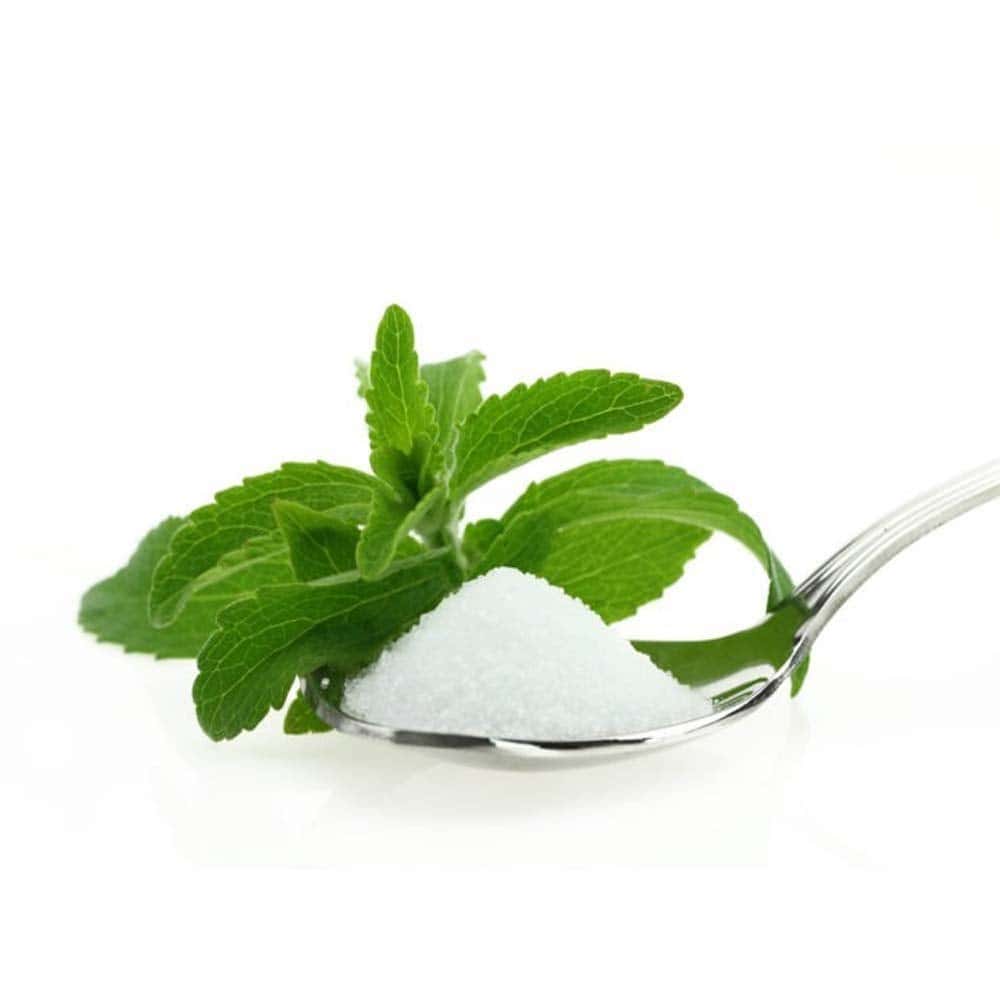
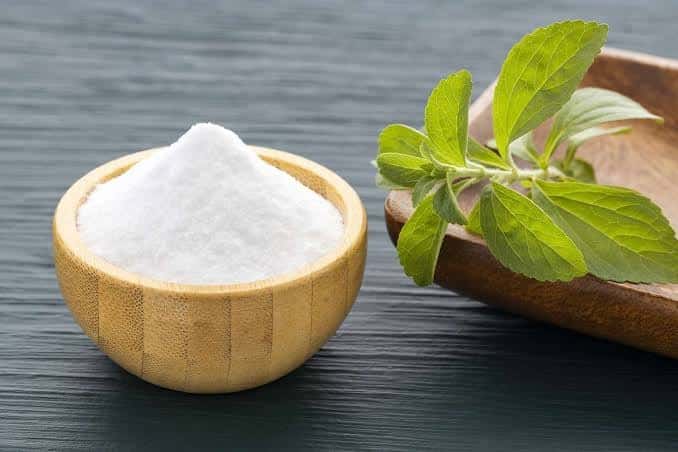
When manufacturers compare “stevia” with sucralose they are usually comparing two food additives: purified steviol glycosides (E 960a and related entries) and sucralose (E 955). Both are high-intensity sweeteners used at parts-per-million levels, but they differ in origin, chemistry, specification and regulatory basis. This comparison uses the EU and JECFA specifications and the US FDA's published positions.
Two different kinds of sweetener
Steviol glycosides are the sweet compounds of the stevia leaf — a steviol backbone with attached sugar units — purified to at least 95 %. Leaf extraction is the classic route; fermentation and enzymatic conversion are also authorised. Sucralose is a chlorinated disaccharide, 1,6-dichloro-1,6-dideoxy-β-D-fructofuranosyl-4-chloro-4-deoxy-α-D-galactopyranoside (C₁₂H₁₉Cl₃O₈), also known as 4,1′,6′-trichlorogalactosucrose. Note that the dried stevia leaf is a separate material with a much more limited legal status than the purified glycosides.
Side-by-side comparison
| Parameter | Steviol glycosides (stevia) | Sucralose |
|---|---|---|
| EU number / INS | E 960a–E 960d / INS 960a, 960b | E 955 / INS 955 |
| Assay (EU specification) | ≥ 95 % steviol glycosides, dried basis | 98–102 % C12H19Cl3O8, anhydrous basis |
| Appearance (EU) | White to light yellow powder | White to off-white, practically odourless crystalline powder |
| Solubility in water | Very slightly to freely soluble, depending on composition (JECFA) | Freely soluble (EU) |
| Sweetness vs sucrose | About 200–300× (JECFA); 200–400× (FDA) | About 600× (FDA) |
| JECFA ADI | 0–4 mg/kg bw, expressed as steviol | 0–15 mg/kg bw |
| EFSA position | ADI 4 mg/kg bw/day as steviol equivalents retained (2024) | ADI 15 mg/kg bw/day retained (2026 re-evaluation) |
| US status | ≥ 95 % purity: GRAS notices, FDA no questions | Food additive, 21 CFR 172.831 — general-purpose sweetener under GMP |
| EU dosing basis | Steviol equivalents | Sucralose as such |
Sweetness and dosing
FDA describes sucralose as about 600 times sweeter than sugar and steviol glycosides as 200 to 400 times, so on intensity alone less sucralose is needed by weight. The two are also limited differently in the EU: sucralose maximum levels are expressed as sucralose, while steviol glycoside levels are expressed as steviol equivalents, which means the permitted weight of a stevia grade depends on its composition — Reb A converts at 0.33, Reb M at 0.25. Compare permitted use levels category by category rather than assuming one sweetener can replace the other at a fixed ratio.
Processing and stability
FDA notes that sucralose is heat stable and stays sweet at high temperatures. In its 2026 re-evaluation, however, EFSA could not conclude on a proposed extension of sucralose to fine bakery wares because of uncertainty about chlorinated compounds that may form across the wide range of baking processes, and it recommended a review of the EU specifications. For steviol glycosides, the specifications define a 1 % solution pH of 4.5–7.0 but say nothing about process stability, so ask for the producer's stability data for your conditions — acidic beverages, retorting or baking — before you commit to a formula.
Regulatory position by market
- EU — both are authorised additives, each with its own list of permitted food categories and maximum levels; both are permitted at quantum satis in table-top sweeteners.
- United States — sucralose is a listed food additive (21 CFR 172.831); high-purity steviol glycosides rely on GRAS notices, and stevia leaf and crude extracts are not permitted as sweeteners (Import Alert 45-06).
- JECFA / Codex — both have JECFA ADIs: 0–15 mg/kg bw for sucralose (1990) and 0–4 mg/kg bw as steviol for steviol glycosides, confirmed in 2026.
- Thailand — steviol glycosides are a food additive whose quality must follow the Codex/JECFA specifications; check the destination's rules for each sweetener before export.
What to check on the certificate of analysis
The EU specifications point to different quality risks for each sweetener, so the COA parameters you ask for should differ too.
- Steviol glycosides (E 960a) — total steviol glycosides (≥ 95 %, and which specification is meant), the principal glycoside, loss on drying (≤ 6 %), total ash (≤ 1 %), residual methanol (≤ 200 mg/kg) and ethanol (≤ 5 000 mg/kg), arsenic and lead (≤ 1 mg/kg each).
- Sucralose (E 955) — assay (98–102 % on the anhydrous basis), water (≤ 2.0 %), other chlorinated disaccharides (≤ 0.5 %), chlorinated monosaccharides (≤ 0.1 %), triphenylphosphine oxide (≤ 150 mg/kg), methanol (≤ 0.1 %) and lead (≤ 1 mg/kg).
How to choose
- Origin requirement — if your product brief requires a plant-derived sweetener, specify leaf-extracted steviol glycosides (E 960a) and say so in the enquiry; fermentation and enzymatic grades are separate entries.
- Process — for baked goods, check the EU permitted uses and any stability data for both options.
- Dosing headroom — compare the maximum levels for your food category, remembering the steviol-equivalent basis for stevia grades.
- Taste target — JECFA notes that several minor steviol glycosides have more favourable sensory characteristics than the major ones, which led to grades richer in glycosides such as Reb M; confirm any choice in tasting trials.
- Market list — confirm each destination's approval and labelling rules before ordering.
Both ingredients belong to the wider group of high-intensity sweeteners. For single-glycoside options, compare Reb A and Reb M in our Reb A vs Reb M vs Reb D guide.
Frequently asked questions
Is stevia sweeter than sucralose?
No. FDA describes sucralose as about 600 times sweeter than sugar and steviol glycosides as 200–400 times.
Do stevia and sucralose have the same ADI?
No. JECFA's ADI is 0–15 mg/kg bw for sucralose and 0–4 mg/kg bw, expressed as steviol, for steviol glycosides. EFSA kept both values in its latest reviews (2024 for steviol glycosides, 2026 for sucralose).
Is dried stevia leaf an alternative to sucralose?
Not as a food sweetener in most regulated markets: the US does not consider stevia leaf or crude extracts GRAS, and in the EU leaf extracts used as sweeteners must meet the E 960 additive rules. Purified steviol glycosides are the comparable ingredient.
Sources & references
- RegulatorCommission Regulation (EU) No 231/2012 laying down specifications for food additives — consolidated text of 18 August 2026 — EUR-Lex, Publications Office of the European Union
- RegulatorRegulation (EC) No 1333/2008 on food additives — consolidated text of 18 August 2026 (Annex II) — EUR-Lex, Publications Office of the European Union
- International organisation(Framework for) Steviol glycosides — specifications monograph, 96th JECFA (2023), FAO JECFA Monographs 31 — Food and Agriculture Organization of the United Nations / JECFA
- International organisationEvaluations of the Joint FAO/WHO Expert Committee on Food Additives (JECFA) — Steviol glycosides — World Health Organization
- International organisationEvaluations of the Joint FAO/WHO Expert Committee on Food Additives (JECFA) — Sucralose — World Health Organization
- RegulatorEFSA FAF Panel (2024). Extension of the authorisation of use of steviol glycosides (E 960a–d) and modification of the ADI for steviol. EFSA Journal 22:9045 — European Food Safety Authority
- RegulatorEFSA FAF Panel (2026). Re-evaluation of sucralose (E 955) as a food additive and evaluation of a new application on extension of use in fine bakery wares. EFSA Journal 24:9854 — European Food Safety Authority
- RegulatorAspartame and Other Sweeteners in Food — U.S. Food and Drug Administration
- Regulator21 CFR 172.831 Sucralose — Electronic Code of Federal Regulations (eCFR)
- RegulatorImport Alert 45-06: Detention without Physical Examination of Stevia Leaves, Crude Extracts of Stevia Leaves and Foods Containing Stevia Leaves and/or Stevia Extracts (published 09/23/2026) — U.S. Food and Drug Administration
- GovernmentGuideline on steviol glycosides with both flavouring and sweetener properties (revised February 2026) — Food Division, Thai Food and Drug Administration — Thai Food and Drug Administration, Ministry of Public Health