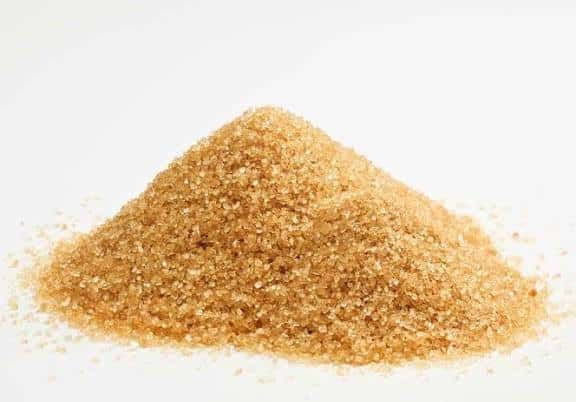
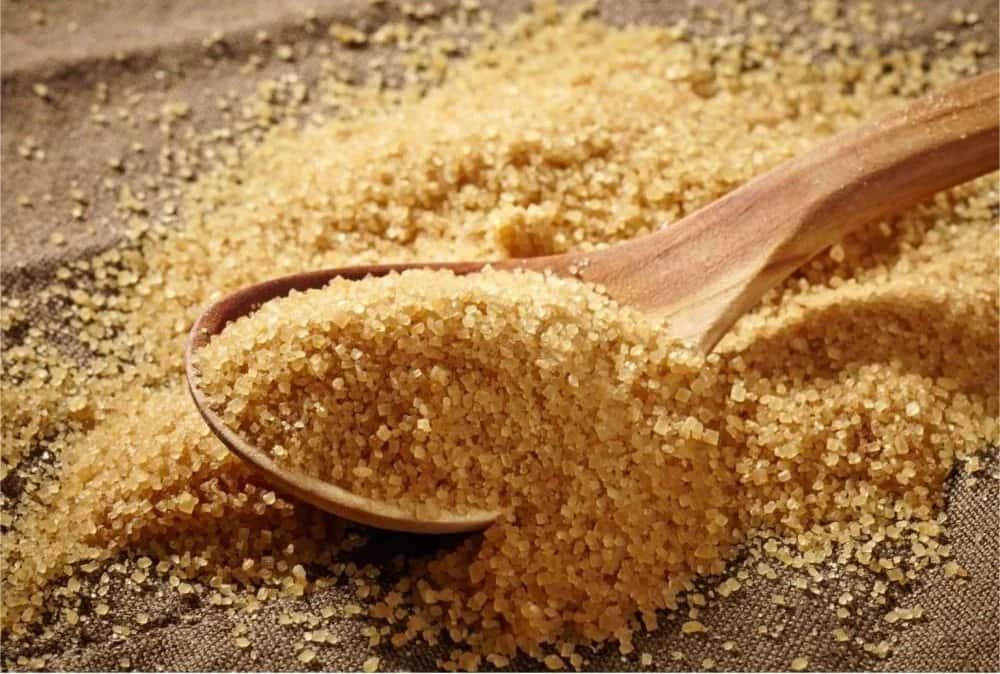
The short answer
Raw sugar is partially purified cane sugar: golden-brown crystals still coated with a film of molasses, made mainly as feedstock for refineries. Refined sugar is what comes out of that refining — white crystals of very high purity, ready for food and beverage use. In Thailand the line between them is set by regulation: raw sugar must reach at least 97.00 °Z polarisation with colour of 601 ICUMSA units (IU) or more, while refined sugar must reach 99.80 °Z with colour of 0–45 IU.
How raw sugar is made
At the mill, cane is crushed and the juice is clarified, evaporated to syrup and boiled until sucrose crystallises. Centrifuges separate the crystals from the mother liquor, and the crystals leave the mill without further purification — which is why each one still carries a thin layer of molasses. Codex describes raw cane sugar in much the same terms. The molasses film gives raw sugar its colour, a water content of roughly 0.25–1.1 % according to the German insurers’ cargo service TIS-GDV, and a strong tendency to take up moisture.
Mills can push quality higher by boiling and washing more thoroughly. The result is still raw sugar under Thai rules, but with higher pol and lower colour — the commercial grades known as Thai Hi-Pol and VHP.
How refined sugar is made
A refinery — a stand-alone plant in the importing country, or a refinery attached to a Thai mill — re-dissolves raw sugar or mill syrup, then clarifies, decolourises and filters the liquor before re-crystallising it under vacuum. The crystals are centrifuged, dried and conditioned in storage so that their moisture is stable before bagging.
Better raw sugar makes refining cheaper. A paper presented to the 2010 ISSCT congress cites a refinery analysis in which moving from conventional raw sugar (98.4 pol, 3,800 IU) to VHP sugar (99.4 pol, 800 IU) removed the affination step, reduced low-grade massecuite handling and saved energy and utilities. Raw-sugar contracts reward higher pol with premiums, as the benchmarks below show.
Raw and refined sugar side by side
| Aspect | Raw sugar | Refined sugar |
|---|---|---|
| Thai class (OCSB) | Pol ≥ 97.00 °Z; colour ≥ 601 IU | Pol ≥ 99.80 °Z; colour 0–45 IU |
| Codex description | Partially purified sucrose; crystals covered by a film of cane molasses | Purified, crystallised sucrose (white sugar: pol ≥ 99.7 °Z) |
| Exchange benchmark | ICE Sugar No. 11 — 96° average pol basis; no colour or moisture term | ICE White Sugar — pol ≥ 99.8°, moisture ≤ 0.06 %, colour ≤ 45 IU |
| Direct consumption | No — refined first (some is used in fermentation and feed) | Yes |
| Usual shipment | Bulk, by vessel | Bags, typically 50 kg, usually in containers |
| Main Thai export destinations, 2025 | Indonesia, South Korea, Vietnam, Japan | Cambodia, Philippines, Laos, China, Malaysia, Vietnam (white and refined) |
| Thai exports, calendar 2025 (raw value) | 2,498,699 t | 3,656,424 t (white and refined combined) |
Who buys raw sugar
Raw sugar’s main customers are refiners. USDA notes that Indonesia and South Korea — the two largest buyers of Thai raw sugar, taking 1,560,086 t and 503,743 t respectively in calendar 2025 — both have large domestic refining industries. Vietnam (131,301 t) and Japan (106,500 t) came next.
Outside refineries, TIS-GDV notes that raw sugar is used without further processing in breweries, the yeast industry and animal feed, and Thai mills also list distilleries and vinegar makers among raw-sugar buyers. Because raw sugar is a processing input, its contract terms centre on what the buyer recovers and processes: pol first, then colour and moisture, and for some buyers parameters such as dextran and starch — Brazil’s published VVHP export specification includes both.
Some importing markets have their own named grades. KSL’s One Report describes a ‘K-Specs’ raw sugar for Korea with pol not exceeding 99.49 on a dry basis and colour not exceeding 3,000 IU, and KTIS reports selling ‘J-Spec’ raw sugar to customers in Japan.
Benchmarks and how prices are quoted
- ICE Sugar No. 11 prices raw centrifugal cane sugar on a 96° average-polarisation basis, FOB the receiver’s vessel in the country of origin; Thailand is a deliverable origin. Sugar above 96° earns allowances up to 99.3°, and sugar between 95° and 96° carries a deduction that drops out of the schedule from the March 2028 delivery month. The contract has no colour, moisture or ICUMSA term.
- ICE White Sugar prices white or refined sugar at pol ≥ 99.8°, moisture ≤ 0.06 % and colour ≤ 45 IU, FOB and stowed, in 50-tonne lots; Thailand is a deliverable country.
- Thai Hi-Pol physical cargoes are assessed weekly by S&P Global Platts as a premium to front-month No. 11 (min. 98.5° pol, wet basis, FOB Thai ports).
- The white sugar premium, published by Platts as the front-month ICE White price minus the front-month No. 11 price converted to US dollars per tonne, shows the price gap between refined and raw sugar on the two exchanges.
Physical contracts can depart from all of these — a white-sugar contract may set its own colour band, and a raw-sugar contract its own pol scale — so the contract, not the benchmark, is what the shipment’s certificate of analysis is checked against. See how to read a sugar specification and the sugar COA guide.
Which should you buy?
If you run a refinery or an industrial fermentation process, raw cane sugar — or a higher grade such as Hi-Pol raw sugar or VHP raw sugar — is the economic input, normally bought in vessel-sized lots; Platts’ Thai Hi-Pol benchmark reflects 12,000-tonne parcels. If you make food or beverages or distribute sugar, you need a white or refined grade such as ICUMSA 45 refined sugar or ICUMSA 150 white sugar. To choose between those two, read refined sugar vs white sugar.
Brown sugars are a separate family: natural brown sugar keeps some molasses like raw sugar, but it is made and sold for direct consumption.
Frequently asked questions
Can raw sugar be eaten directly?
Thai raw sugar is not intended for direct consumption — KTIS describes it as needing refining into white or refined sugar first. Some raw sugar is used unrefined in fermentation and feed. For a brown sugar made for food use, see natural brown sugar.
Is raw sugar the same as brown sugar?
No. Brown sugars are made for direct consumption, and Codex treats soft brown sugar as its own product. Raw sugar is a refinery feedstock that is brown because of its molasses film.
Is raw sugar shipped in bags?
Raw sugar is typically carried in bulk vessels. Some Thai mills dry and bag higher-grade raws — Buriram Sugar, for example, packs its VHP in 50 kg and 15 kg bags for export. State the packing you need in your enquiry.
Why is raw sugar priced on pol?
Pol approximates the sucrose content of the sugar. ICE No. 11 sets a 96° basis and adds allowances for higher pol — for example +1.00 % of the price at 97° — up to 99.3°. See what is high-pol sugar for the full scale.
How much raw sugar is a normal order?
Raw sugar is normally traded in vessel lots; the Platts Thai Hi-Pol assessment reflects cargoes of 8,000–12,000 tonnes. ANUTIDA confirms quantity and packing in the quotation.
Sources & references
- GovernmentKM: factory-unit cane and sugar production control manual (sugar types and quality, Cane and Sugar Board notification B.E. 2564) — Office of the Cane and Sugar Board (OCSB)
- Standards bodyCodex Standard for Sugars (CXS 212-1999, amended 2001) — FAO/WHO Codex Alimentarius Commission
- RegulatorSugar No. 11 Rules (Chapter 11 rulebook) — ICE Futures U.S.
- RegulatorICE Futures White Sugar Futures Contract — Contract Rules (Section IIII) — ICE Futures Europe
- Trade pressSpecifications Guide: Global Sugar (August 2023) — S&P Global Platts
- GovernmentThailand: Sugar Annual (GAIN report TH2026-0011), 20 April 2026 — USDA Foreign Agricultural Service
- Industry bodyRaw sugar — cargo information — Transport Information Service (GDV, German Insurance Association)
- Industry bodyCarefully to Carry (Consolidated Edition 2023), Chapter 25 — Sugar — UK P&I Club
- ResearchKochergin, V. (2010) Studies of long-term storage of high quality raw sugar, Proc. ISSCT Vol. 27 — International Society of Sugar Cane Technologists
- ResearchOliveira et al. (2007), sugar specifications, Ciência e Tecnologia de Alimentos 27 (supl.), Tabela 1 — Ciência e Tecnologia de Alimentos (SBCTA)
- RegulatorKTIS Form 56-1 One Report 2025 (English), filed with SEC Thailand — Kaset Thai International Sugar Corp. PCL / SEC Thailand