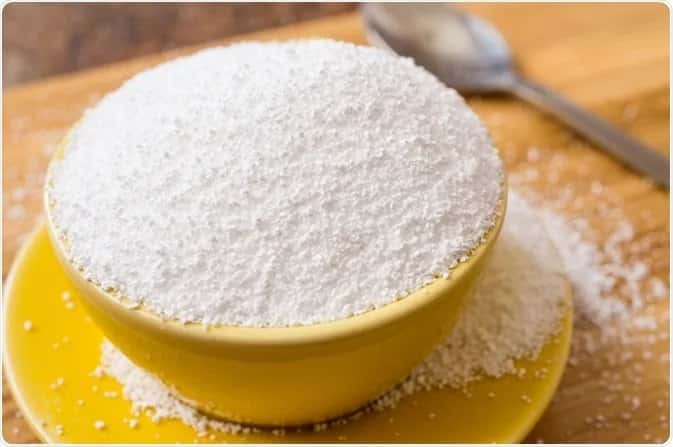
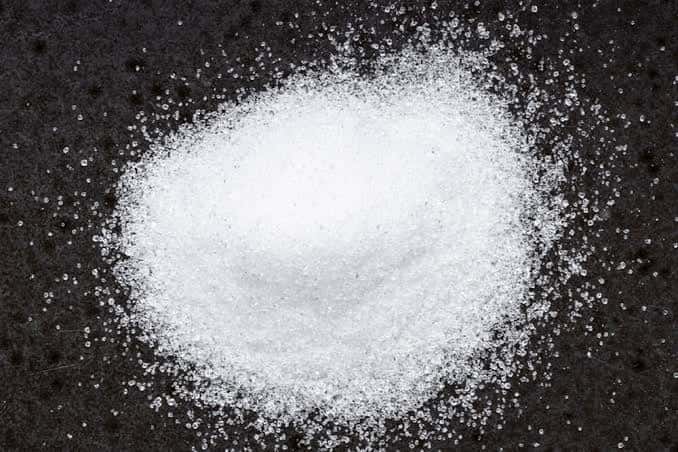
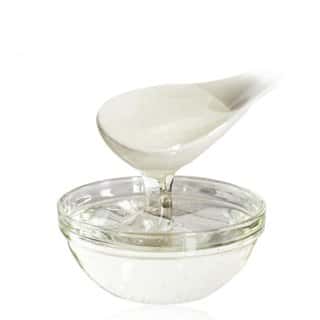
Sorbitol is bought in two very different physical forms: a white crystalline powder and a clear syrup, usually sold as “sorbitol 70%”. The difference goes beyond water content. Under JECFA and EU law they are two separate additives, sorbitol (INS/E 420(i)) and sorbitol syrup (INS/E 420(ii)), with different definitions, assays and purity limits. Choosing the right one affects your formula, your intake equipment, your freight cost and the additive name on your label.
Two identities, one polyol
Crystalline sorbitol is obtained by hydrogenating D-glucose and is mainly D-sorbitol. The rest consists of related polyols such as mannitol, iditol and maltitol. JECFA requires at least 97.0% total glycitols and at least 91.0% D-sorbitol on the anhydrous basis. The EU describes it as a white hygroscopic powder, crystalline powder, flakes or granules.
Sorbitol syrup is made by hydrogenating glucose syrup. It contains D-sorbitol, D-mannitol and hydrogenated saccharides, and must contain at least 50% D-sorbitol on the anhydrous basis. The non-sorbitol part depends on the glucose syrup used. It is either mainly mannitol or mainly hydrogenated oligosaccharides, and JECFA notes that the oligosaccharide type is a non-crystallising syrup.
Side-by-side specification
| Parameter | Sorbitol powder (E 420(i)) | Sorbitol syrup (E 420(ii)) |
|---|---|---|
| INS number | 420(i) | 420(ii) |
| Made from | D-glucose, hydrogenated | Glucose syrup, hydrogenated |
| Assay (JECFA) | ≥ 97.0% total glycitols; ≥ 91.0% D-sorbitol (anhydrous) | ≥ 99.0% hydrogenated saccharides; ≥ 50.0% D-sorbitol (anhydrous) |
| Total solids (EU) | — | ≥ 69% |
| Water, Karl Fischer | ≤ 1% (JECFA); ≤ 1.5% (EU) | ≤ 31% (JECFA and EU) |
| Reducing sugars (as glucose) | ≤ 0.3% | ≤ 0.3% |
| Total sugars (as glucose) | ≤ 1% | — |
| Conductivity, 20 °C (EU) | ≤ 20 μS/cm (20% dry-solids solution) | ≤ 10 μS/cm (product as such) |
| Appearance | White hygroscopic powder, crystalline powder, flakes or granules | Clear, colourless aqueous solution |
| Relative sweetness (sucrose = 100) | ≈ 50–70 | ≈ 25–50 |
| Commonly supplied in | 25 kg bags, fibre drums | Drums, IBC totes, flexitanks, road tankers |
| HS subheadings to check (confirm with broker) | 2905.44 (D-glucitol) | 2905.44 or 3824.60 (sorbitol other than 2905.44) |
What “70%” on sorbitol solution actually means
“Sorbitol 70%” is a trade name for the solids content, not a sorbitol assay. The US Pharmacopeia's sorbitol solution contains 69–71 g of total solids per 100 g. The EU specification for sorbitol syrup requires at least 69% total solids, and JECFA caps water at 31%. Within those solids, the regulatory minimum is only 50% D-sorbitol on the anhydrous basis, so two syrups both sold as “70%” can differ substantially in D-sorbitol content and behaviour. If D-sorbitol content matters to you, specify a minimum rather than relying on the name, and check it on the COA.
The water content also changes the economics. A syrup with around 30% water ships about 0.3 tonnes of water with every tonne of product, so compare powder and syrup offers on a dry-solids basis, including freight and packaging.
Crystallising or non-crystallising syrup?
This is the decision buyers most often forget to specify. A crystallising sorbitol solution consists essentially of D-sorbitol with a small amount of mannitol and related polyols. This matches the classic USP description of sorbitol solution. A non-crystallising syrup contains hydrogenated oligosaccharides carried over from the glucose syrup, which keep the sorbitol in solution. Both can meet E 420(ii). Choose the non-crystallising type where the syrup must stay clear and pumpable in your process or product, and the crystallising type where you need a high D-sorbitol content. For pharmaceutical use, name the pharmacopoeial monograph you buy against. Put the type on your RFQ and in your specification.
Which form for which application
- Choose powder for dry blends and other dry processes, and wherever added water is unwanted or the sorbitol must stay solid.
- Choose syrup for humectancy in liquid and semi-liquid systems such as soft confectionery, toothpaste and pharmaceutical syrups. It is also the practical choice when you can receive bulk liquid deliveries.
- Either form works in many confectionery and bakery recipes. US good manufacturing practice allows sorbitol up to 99% in hard candy, 98% in soft candy, 75% in chewing gum and 30% in baked goods, and the right form depends on your process water balance.
If you are still deciding between polyols rather than forms, our comparison of sorbitol and maltitol covers sweetness, moisture behaviour and browning.
Handling and logistics
- Powder is hygroscopic and should be kept in closed packaging in a cool, dry place. It is commonly packed in 25 kg lined bags or fibre drums; reseal part-used bags.
- Syrup is commonly shipped in drums of about 250–300 kg, IBC totes, flexitanks or stainless-steel road tankers. Check that pumps, hoses and intake tanks suit a viscous syrup before switching from powder.
- See logistics for container and bulk-shipping options. The packaging format for your order is confirmed in the quotation.
Customs and labelling
In the Harmonized System, subheading 2905.44 covers D-glucitol (sorbitol), while 3824.60 covers “sorbitol other than that of subheading 2905.44”. Which subheading applies to a given product depends on its composition, so confirm the classification with your customs broker before import. On the label, the additive name follows the identity: E 420 covers both forms in the EU. EU foods containing more than 10% added polyols must carry “excessive consumption may produce laxative effects”. In the US, sorbitol is GRAS under 21 CFR 184.1835, which requires “Excess consumption may have a laxative effect” where foreseeable intake may reach 50 g a day.
RFQ checklist
- Identity: E 420(i) crystalline sorbitol or E 420(ii) sorbitol syrup.
- For syrup: crystallising or non-crystallising, minimum dry solids and minimum D-sorbitol content.
- For powder: particle-size range, which is not set by the food specifications.
- Specification basis: JECFA, EU Regulation 231/2012, FCC or a named pharmacopoeia.
- Packaging, annual volume, delivery frequency and destination port.
- Documents required with each lot, starting with the Certificate of Analysis.
Full specifications, regulatory details and FAQs are on our sorbitol product page, and the wider polyol range is under sugar alcohols and polyols.
Frequently asked questions
Is sorbitol syrup the same additive as sorbitol powder?
Both are E 420 in the EU, but they are separate entries with separate specifications: E 420(i) sorbitol and E 420(ii) sorbitol syrup.
Does “sorbitol 70%” mean 70% D-sorbitol?
No. It refers to total solids (about 69–71 g per 100 g). The regulatory minimum D-sorbitol content of sorbitol syrup is 50% on the anhydrous basis.
Which form is cheaper?
Compare offers on a dry-solids basis. Syrup carries up to 31% water, which you pay to ship, but it can be delivered in bulk.
Sources & references
- International organisationSorbitol (INS 420(i)) — JECFA specification monograph, FAO JECFA Monographs 1 — FAO/WHO Joint Expert Committee on Food Additives (JECFA), FAO
- International organisationSorbitol syrup (INS 420(ii)) — JECFA specification monograph, FAO JECFA Monographs 1 — FAO/WHO Joint Expert Committee on Food Additives (JECFA), FAO
- RegulatorCommission Regulation (EU) No 231/2012 laying down specifications for food additives (consolidated text of 18.08.2026) — European Union (EUR-Lex)
- RegulatorRegulation (EU) No 1169/2011 on the provision of food information to consumers (consolidated text of 01.04.2025) — European Union (EUR-Lex)
- Government21 CFR 184.1835 — Sorbitol — US Food and Drug Administration (eCFR)
- GovernmentSugar Alcohols (Polyols) and Polydextrose Used as Sweeteners in Foods — Health Canada
- GovernmentPubChem compound record: D-Sorbitol (CID 5780), incl. HSDB-sourced use and handling data — US National Library of Medicine
- CustomsCustoms Tariff 2026 — Chapter 29 (HS 2905.44 D-glucitol (sorbitol)) — Canada Border Services Agency
- CustomsCustoms Tariff 2026 — Chapter 38 (HS 3824.60 Sorbitol other than that of subheading 2905.44) — Canada Border Services Agency